Europe Just Raised the Bar for Crypto, and Stellar Is Already Built for It

A Hard Deadline Finally Arrives
For years, Europe’s Markets in Crypto-Assets Regulation felt like a distant target. National grace periods kept pushing it back. That era ended on July 1, 2026, when the transitional window closed across every EU and EEA state. Any crypto firm serving European clients without full authorization now operates outside the law. There are no more carve-outs left to hide behind. Ripple recently confirmed it cleared this bar, receiving full MiCA authorization from Luxembourg’s financial regulator. The license lets it serve institutions across all 30 EEA countries. It is a win for one company, but the bigger story is what it signals. Compliance in crypto has shifted from optional to mandatory, for everyone.
Why This Changes Who Gets to Compete
MiCA does more than add paperwork. It forces every serious platform to prove it can meet reserve requirements, disclosure standards, and anti-money laundering rules. That happens before a firm can touch a single euro from an EU client. Costs rise for smaller projects. But the rules also create a filter that favors infrastructure already built around transparency and speed. Regulators are not just checking boxes either. National authorities can now fine noncompliant firms up to 12.5 percent of global turnover. The incentive to get licensed properly has never been stronger. For blockchains chasing institutional stablecoins and tokenized assets, this is where technical fit meets regulatory readiness.
Stellar Was Already Speaking This Language
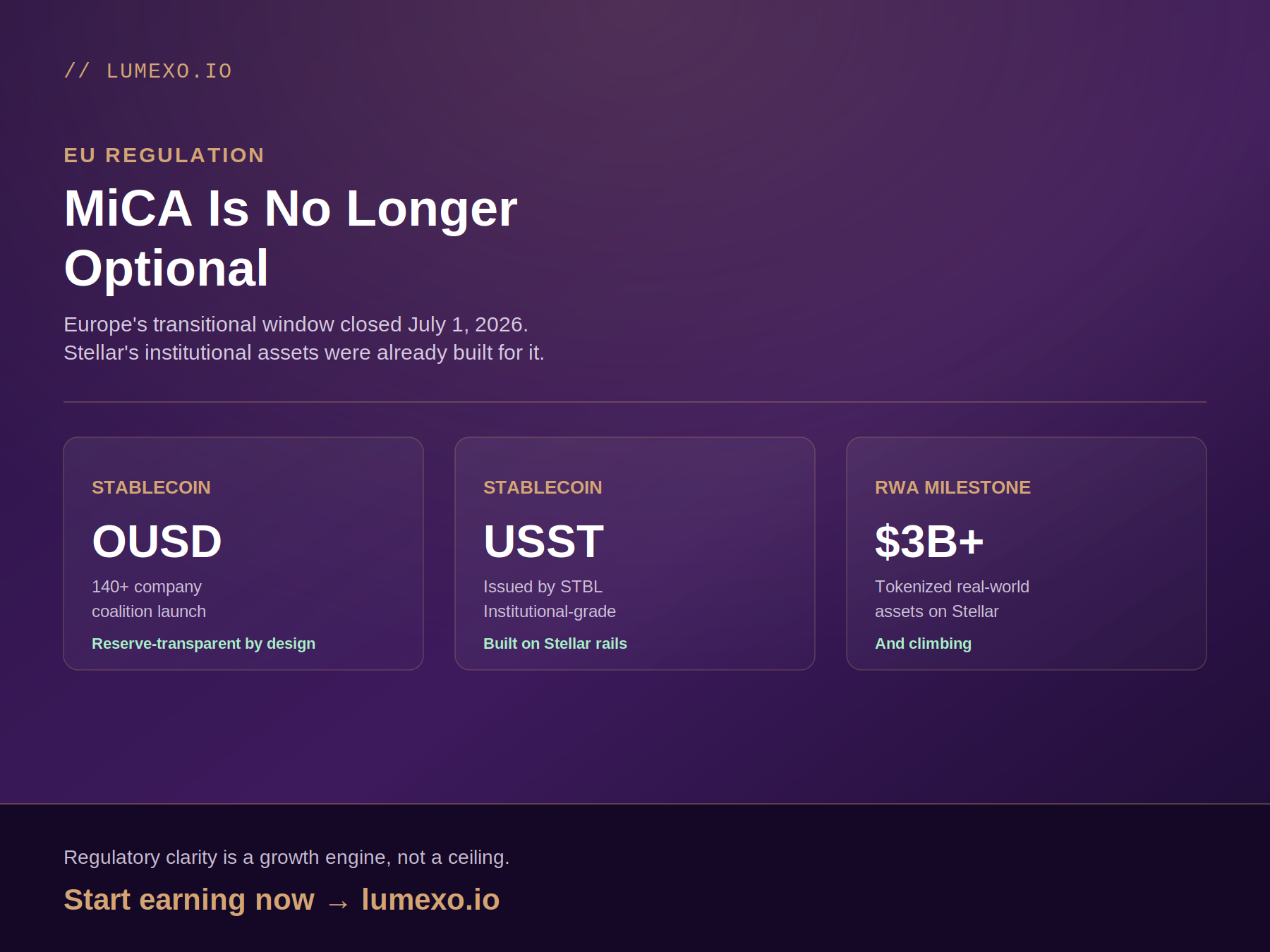
While much of the industry scrambled toward the July deadline, Stellar’s ecosystem had been building differently. Institutional-grade stablecoins like OUSD, launched by a coalition of more than 140 companies, were designed with reserve transparency in mind from day one. USST from STBL followed the same approach. Neither was retrofitted after the fact to satisfy regulators. Stellar also recently crossed the 3 billion dollar mark in tokenized real-world assets. A pattern emerges here. The network was not chasing MiCA compliance reactively. It was building toward the same standards MiCA now demands.
Regulatory Clarity Is a Growth Engine, Not a Ceiling
It is tempting to read stories like Ripple’s license as competitive threats. A more accurate lens is different, though. Europe just validated an entire model: compliant, transparent, institution-ready crypto infrastructure. Every fully licensed provider makes the next one easier to justify to boards and regulators elsewhere. That tailwind lifts networks like Stellar too. Its low fees, fast settlement, and native support for tokenized assets make it a natural home for the compliant products this new era rewards.
Where This Leaves Everyday Users
None of this regulatory maneuvering needs to feel complicated for the person actually holding and trading assets. Institutions will keep sorting out licenses and compliance frameworks behind the scenes. Everyday users still need a simple way to access the assets moving through this more transparent system. Lumexo offers exactly that. It is an easy, fast trade in the Stellar ecosystem, whether that means swapping stablecoins, tracking tokenized assets, or simply holding funds in a non-custodial wallet built for where crypto is actually heading.
Sources