Stellar Just Pushed Its Speed Ceiling to 3,351 TPS

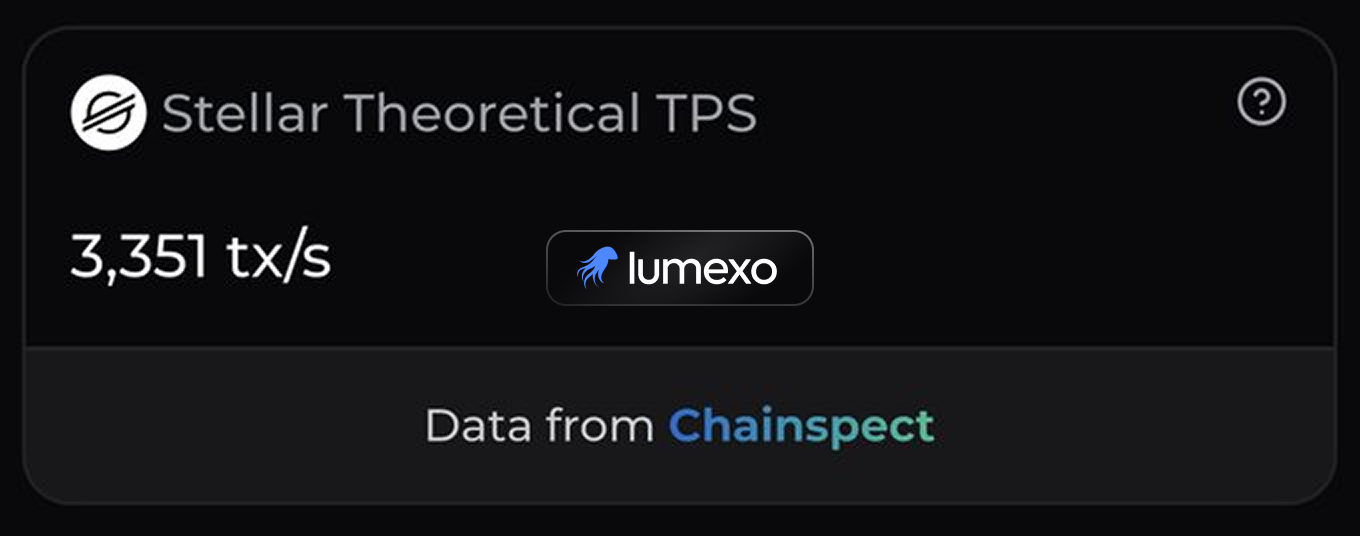
Stellar’s engineering team keeps quietly rewriting what a payments network can handle. The latest benchmark from Chainspect puts Stellar’s theoretical maximum throughput at 3,351 transactions per second. That is a jump of 65% over the previous ceiling. For a network built to move money and tokenized assets at global scale, this is not a small update. It signals that the infrastructure underneath everyday transactions is getting faster.
Why theoretical TPS actually matters
Theoretical TPS is not the number on a live dashboard. Instead, it represents the maximum throughput the protocol can sustain under ideal conditions. Stellar tests this through its public supercluster benchmarking framework. Because the methodology is open source, anyone can verify how the number was reached. Chainspect reviewed the latest results and updated its dashboard to match. That is why the figure now appears on chainspect.app next to real-time and max-recorded TPS for dozens of other chains.
The bigger roadmap behind the number
This benchmark did not appear out of nowhere. The Stellar Development Foundation has run a multi-year effort to push Core’s theoretical throughput toward 5,000 TPS. Recent protocol upgrades introduced multi-threaded smart contract execution. In addition, they added smarter caching for Soroban. Each stellar-core release publishes fresh benchmark results. So this 3,351 figure is one data point in a steady upward trend, not a one-time spike. Node operators do not need new hardware to benefit. The gains come from software-level parallelism, not brute-force scaling.
What higher throughput means for real usage
Raw TPS numbers only matter if they translate into a better experience for actual users. Still, a higher theoretical ceiling gives Stellar more headroom as institutional volume grows. That includes tokenized funds, stablecoin settlement, and remittance corridors already running on Stellar rails. A network that processes more transactions per second, without raising fees or slowing settlement, can absorb heavier real-world load. That matters as institutions like Franklin Templeton and MoneyGram bring more activity on-chain.
Where this leaves everyday users
For most people, none of this shows up as a headline number in an app. Instead, it shows up as transactions that clear fast and stay cheap, even as more activity moves onto the network. That is exactly the experience Lumexo is built to deliver. As a non-custodial trading platform running on Stellar, Lumexo gives users direct access to DEX trading, Blend lending markets, and stablecoins like USDC and EURC. All of it runs on a network that keeps raising its own performance bar. As Stellar’s infrastructure scales, Lumexo scales with it, without asking users to give up control of their funds.