Stellar’s Next Upgrade Makes Smart Contracts Easier to Build and Faster to Run

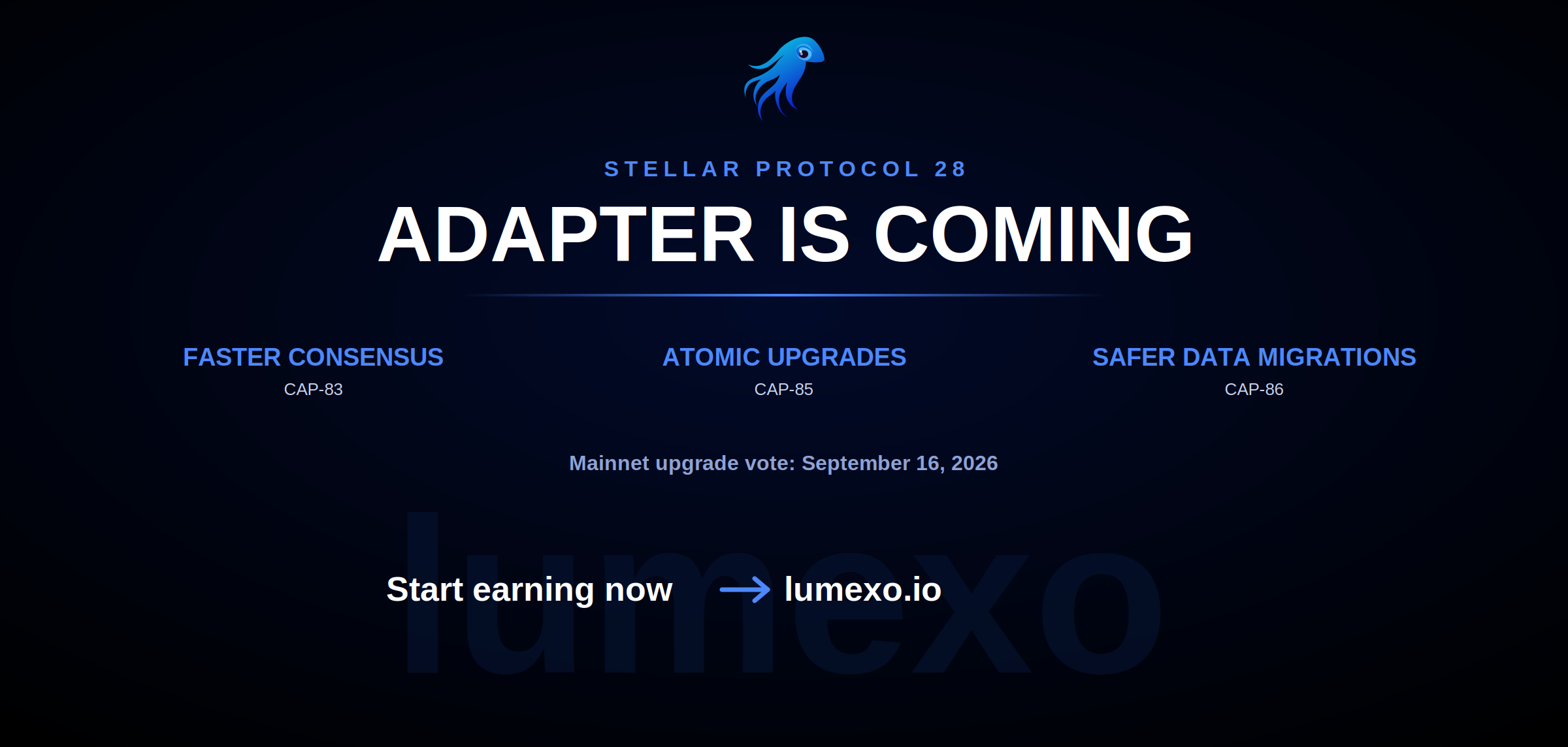
Stellar just announced its next network upgrade, and this one is built for developers. Protocol 28, nicknamed Adapter, heads to a mainnet vote on September 16, 2026, following a testnet vote on August 27. It brings three changes that touch consensus and smart contract management alike. For a network pulling in institutional players and RWA projects, this kind of infrastructure work matters as much as the headline partnerships.
Consensus That Doesn’t Wait Around
The most technical piece lives under the hood. Right now, validators need a complete transaction set before confirming the next ledger, and sharing that data across the network takes time. A change called CAP-83 lets validators start voting before the full set arrives. It also gives them a clean way to drop a transaction set that shows up late or broken. Nothing changes for everyday users here. The benefit shows up as smoother throughput, with full performance gains rolling in gradually after mainnet.
Upgrading Contracts Without the Guesswork
Anyone managing a large set of identical smart contracts knows the pain of updating them one by one. A security fix rolled out across hundreds of contract copies can leave some running new code while others lag behind. CAP-85 fixes that. Contracts can now point to a shared, updatable code reference owned by a separate contract. Update that single reference, and every linked contract upgrades together, instantly. Developers from other chains will recognize the pattern, since it mirrors the beacon proxy approach used elsewhere. For teams running large deployments, this removes a real source of risk.
Letting Contract Data Grow Up
Contracts change over time. Fields get added, others become unnecessary, and interfaces evolve. Today, Stellar’s host functions expect data to match an exact shape, so any mismatch causes a rejection. In some cases, that has left contracts stuck mid-migration. CAP-86 introduces new functions that tolerate missing or extra fields instead of failing outright. This gives developers a supported path to move contract data to a new structure. Builders won’t need to change how they write contracts; they just rebuild against an updated SDK once it ships.
A Pattern Worth Noticing
Together, these changes make Stellar sturdier for real financial applications without sacrificing speed or low cost. The effort follows the same trajectory as Protocol 23 last September, which focused on parallel transaction processing and archival improvements. Each release chips away at a different friction point for builders, and Adapter continues that habit. It is quiet progress, but the kind that compounds. As more RWA and stablecoin projects choose Stellar, upgrades like this keep the infrastructure ready for the load.
None of this changes how everyday users trade or hold assets on Stellar, but it makes the ecosystem those users depend on more resilient. Platforms like Lumexo, which give people a simple way to trade on the Stellar DEX, tap Blend lending markets, and hold stablecoins like USDC and EURC, benefit directly from a network that keeps getting faster and easier to build on.